
Travel Physical Therapist (PT)
Travel PT Pay: Estimate Take-Home Pay & Compare Contracts

Key takeaways
Two travel PT offers can advertise the same weekly package and still leave you with thousands of dollars' difference. Put both offers inside one fixed calendar window, separate guaranteed pay from conditional payments, estimate taxes on the taxable portion only, then subtract real housing, travel, and licensing costs before you decide.
Two travel physical therapists can accept contracts with the same advertised weekly package and still keep very different amounts. One may start on time, find housing that fits the stipend, and receive every guaranteed hour. The other may lose a week to licensing, pay more for a last-minute rental, or discover that a reimbursement is not paid until completion.
Travel PT pay can’t be judged from one headline number. The useful question is what remains after package structure, estimated taxes, housing and travel costs, licensing expenses, and unpaid gaps are compared over the same period.
This guide shows how to estimate that value, applies the method to two hypothetical contracts, and gives you a repeatable comparison framework you can apply to any written offer.
How Travel PT Pay Packages Work
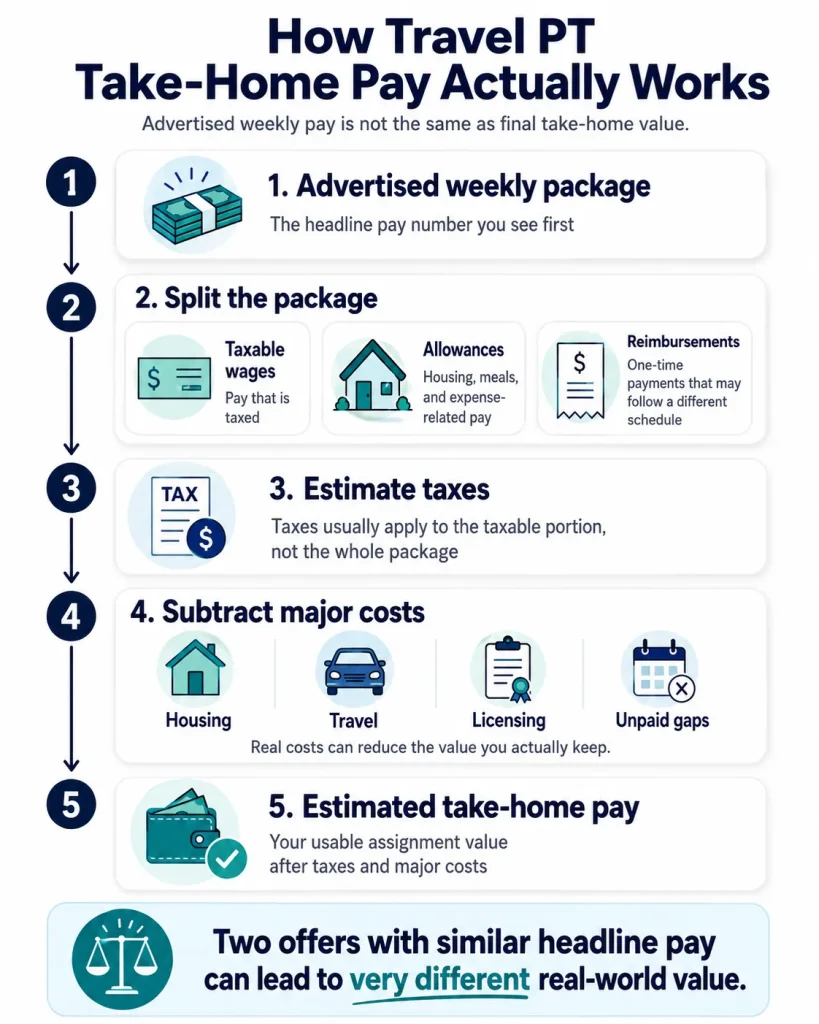
Travel PT offers can be presented as a weekly package rather than an annual salary. A package may include taxable hourly wages, housing and meal allowances often called stipends, and one-time reimbursements for approved travel, licensing, or other assignment costs. The advertised total is useful, but it doesn’t show which dollars are guaranteed, when they are paid, or what expenses the traveler must absorb.
Start by separating recurring compensation from conditional or one-time payments. A completion reimbursement doesn’t have the same value as weekly compensation because it may not be paid until the assignment ends. A licensing reimbursement may require receipts.
Overtime may depend on the facility schedule. A blended weekly figure may also assume all scheduled hours are worked, even when the contract contains cancellation or low-census language.
Guaranteed Compensation Comes First
Record the taxable hourly rate, guaranteed hours, weekly allowances, and any guaranteed weekly minimum. Then list overtime, mileage, bonuses, and reimbursements separately. The calculation should be based on compensation the contract actually guarantees, not the best possible week.
The Package Split Is Not a Tax Shortcut
Taxable wages and employer reimbursements can receive different tax treatment, but the label on a quote doesn’t decide the result. IRS Publication 463 explains accountable-plan, substantiation, and reimbursement rules, while Topic 511 explains travel away from a tax home and temporary versus indefinite assignments. Individual circumstances and the employer’s plan matter, so use a qualified tax professional for personal advice.
Compare Every Offer Over the Same Time Window
Don’t compare one offer’s strongest week with another offer’s full contract. Put both written travel offers on the same calendar window and count only the compensation, reimbursements, housing, licensing, and other costs that occur inside it. If one contract starts later, the reduced paid weeks inside the window show the delay’s effect without adding a second lost-income deduction.
Use salary pages only as market benchmarks, not as substitutes for the written offer. Use current national travel PT salary data to benchmark traveling physical therapist pay, then check California, Texas, Georgia, or Florida when one of those markets is under consideration. The actual comparison should still rely on the specific written contract, actual housing and travel costs, licensing costs, and paid weeks inside the comparison window.
Four Inputs Determine Travel PT Take-Home Pay
“Take-home pay” is familiar shorthand, but no article can calculate your exact bank deposit without your tax information and final payroll records. This comparison framework estimates usable assignment value: what remains inside one shared time window after expected taxes and assignment costs. A strong comparison answers four questions: what is guaranteed, what portion is taxable for you, what the assignment costs to complete, and whether licensing or timing changes the paid weeks.
| Input | What to check | Warning sign |
|---|---|---|
| 1. Guaranteed compensation | Guaranteed hours, taxable wages, expected allowances, paid weeks, and reimbursement timing | A large headline built on uncertain hours or different time windows |
| 2. Estimated taxes | A traveler-supplied estimate on the taxable portion and the facts that affect treatment | Every allowance assumed to be tax-free |
| 3. Housing and travel costs | Rent, utilities, parking, fees, commute, and move-in or travel costs | A statewide benchmark substituted for actual local costs |
| 4. Licensing and timing costs | Eligibility, exams, fees, processing, and paid weeks inside the comparison window | The delayed week is ignored or deducted twice |
Estimated usable assignment value = guaranteed compensation + confirmed reimbursements – estimated taxes – housing and travel costs – licensing and other assignment costs, all measured inside the same comparison window.
1. Guaranteed Compensation
Choose one fixed calendar window for both offers and count only paid weeks and payments that fall inside it. If you compare completed assignments instead, use the same completed length and show any extra calendar time separately.
Do not combine the two methods. Add reimbursements only when their amount, eligibility rules, and payment timing are known. If payment falls after the window, note it separately rather than counting it as cash available during the comparison.
2. Estimated Taxes on Taxable Wages
Use a personal estimate or payroll projection for the taxable portion rather than applying tax to the blended package. State withholding, residence-state rules, filing status, other income, and credits can change the result. Travel reimbursements also depend on the facts of the assignment and the employer’s reimbursement arrangement.
Use IRS Publication 463 and Topic 511 as the federal starting points, then have a qualified tax professional apply those rules to your circumstances. This framework can organize the inputs; it cannot determine your final tax treatment.
3. Total Housing and Travel Costs
Price the metro and commute you would actually accept. Include rent, utilities, parking, deposits that may not be recovered, cleaning and platform fees, pet costs, and transportation. A cheaper unit can still be the more expensive choice when it creates a long commute, frequent tolls, or a second vehicle expense.
HUD Fair Market Rents estimate 40th-percentile gross rent for standard-quality units, while BEA Regional Price Parities compare price levels across states and metropolitan areas. Both can test whether a housing assumption is plausible, but neither is a direct measure of furnished short-term rental prices near a specific facility. Use quotes from real listings near the facility for the housing estimate, and use the benchmarks only as a reasonableness check.
4. Licensing Expenses and Delayed Starts
Count the application, verification, exam, fingerprinting, and other unreimbursed expenses that apply to the specific license path. Then estimate the calendar effect. A one-week unpaid delay can cost more than the license fee, especially when housing or travel arrangements have already begun.
Before estimating timing, use the national PT license guide to identify the full-license or Compact pathway for the state you are considering. Then confirm current requirements with the applicable board or Compact source.
The PT Compact requirements table shows that fees and jurisprudence steps vary by jurisdiction. Compact access can reduce separate-license friction for eligible clinicians, but it does not remove every state requirement.
California also illustrates why the exact pathway matters: endorsement applicants who meet the Board’s conditions may be granted physical therapist license applicant status, but the Board must issue that notice before any work begins, and practice is subject to the supervision requirements in California Code of Regulations sections 1399.10 and 1399.12. An employer must also be willing to provide that supervision. Review California PTLA requirements before relying on that status for a start date.
Travel PT Take-Home Pay Example: Same Headline
The following example compares two invented offers with the same advertised weekly package over one fixed 13-calendar-week decision window. Both are written as 13-week assignments. Offer A starts one week late because of licensing, so only 12 paid weeks fall inside the window; Offer B starts on time and contributes all 13.
Every figure is hypothetical and does not represent a current contract or a real traveler’s tax result. The tax line uses a flat 20% of taxable wages solely to demonstrate the method. For this illustration, both the traveler’s facts and the employer arrangement are assumed to support the stated allowance treatment.
| Input, all figures hypothetical | Offer A | Offer B |
|---|---|---|
| Advertised weekly package | $2,100 | $2,100 |
| Weekly taxable wages / expected allowances | $1,200 / $900 | $1,000 / $1,100 |
| Comparison window | 13 calendar weeks | 13 calendar weeks |
| Paid weeks inside the window | 12 (one-week licensing delay) | 13 |
| Guaranteed package inside the window | $25,200 | $27,300 |
| Illustrative tax estimate (20% of taxable wages) | minus $2,880 | minus $2,600 |
| Housing and travel costs inside the window | minus $8,400 | minus $5,400 |
| Unreimbursed licensing and credentialing | minus $600 | minus $45 |
| Confirmed reimbursement inside the window | plus $300 in first paid week | plus $500 in first paid week |
| Estimated usable assignment value | about $13,620 | about $19,755 |
The packages look identical at $2,100 per week, yet Offer B finishes about $6,135 ahead inside the same 13-calendar-week window. Offer A has one fewer paid week in the window, while Offer B also carries lower housing and licensing costs.
Under the illustration’s assumptions, Offer B also has a smaller tax estimate. No single factor decides the result.
Offer A may still complete a thirteenth paid assignment week after the window ends. That later week is not counted here because the method includes only compensation and costs inside the chosen window. If you prefer to compare completed assignments, include all 13 paid weeks for each offer, show Offer A’s extra calendar week separately, and do not deduct the delay again as lost income.
The housing line should include every lodging and travel cost incurred inside the window, including pre-start costs when they occur. A completion reimbursement payable after week 13 belongs outside the comparison until it becomes payable.
The example also shows why “weekly take-home” can be misleading. Some costs happen monthly, some once, and some before paid work begins.
Convert every item to the same calendar window first. A weekly equivalent can be calculated afterward, but the full-window total should decide the comparison.
| Calculation | Offer A | Offer B |
|---|---|---|
| Guaranteed package + reimbursement | $25,500 | $27,800 |
| Balance after estimated taxes | $22,620 | $25,200 |
| Balance after housing and travel costs | $14,220 | $19,800 |
| Estimated usable assignment value | $13,620 | $19,755 |

How to Compare Two Travel PT Contracts
Use the same sequence every time. A consistent comparison makes it harder for one attractive headline or one low-cost feature to dominate the decision.
- Choose the comparison window. Use one fixed calendar window for both offers, or compare completed assignments and show any extra calendar time separately.
- Enter guaranteed compensation. Separate taxable wages, expected allowances included in the written offer, guaranteed minimums, and paid weeks inside the window.
- List conditional payments. Record overtime, mileage, completion bonuses, and reimbursements with their eligibility rules and payment dates.
- Enter a personal tax estimate. Apply it to the taxable portion and label the rate and treatment assumptions.
- Price housing and travel. Include every assignment-location cost paid inside the comparison window, not rent alone.
- Add licensing and start-timing effects. Enter direct costs, then reduce paid weeks if a delay falls inside the comparison window. Do not deduct the same week again.
- Record conditions that could change the estimate. Note cancellation or low-census language, repayment clauses, and any condition tied to guaranteed pay or reimbursement.
- Compare the final assignment values. Use the weekly headline only as an input, not the conclusion.
Add Benefits and Between-Contract Costs When They Differ
Two offers can have similar assignment value and still create different annual outcomes. When contracts differ, compare employee insurance premiums, employer retirement contributions, benefit eligibility dates, paid sick time, and whether coverage continues between assignments.
Convert only the costs you can estimate reasonably. Do not assign an invented dollar value to a benefit simply to force a winner.
Also account for costs that sit outside the selected comparison window. A move, temporary lodging before a lease begins, a week without benefits, or travel to the next contract can affect the year even when the current assignment looks strong. Keep those items in a separate annual-planning line so they remain visible without being counted twice in the contract estimate.
Know What the Estimate Cannot Guarantee
This comparison can’t predict final withholding, a facility cancellation, a housing change, or whether a conditional reimbursement will be approved. It also can’t measure clinical support, schedule fit, or how sustainable the workload will feel. Use the calculation to expose financial assumptions, then review the contract and work environment before accepting.
Save the quote, contract, housing estimate, and licensing timeline used in the comparison. When the assignment ends, replace the estimates with actual amounts. That review improves the next comparison and shows which assumptions were reliable.
A higher estimated value does not automatically make one contract the right choice. Clinical support, workload, schedule, location, and personal goals still matter. The comparison does help prevent a financially weaker offer from winning simply because its weekly number is easier to notice.
Five Errors to Avoid When Comparing Travel PT Contracts
1. Mixing Weekly, Monthly, and One-Time Numbers
Convert every value to the same period before comparing. Thirteen weekly payments, three months of rent, and one licensing reimbursement can’t be combined accurately until the time basis is clear.
2. Treating Every Payment as Recurring Income
A one-time travel reimbursement or completion payment shouldn’t be folded into the weekly package without a label. Record it once and count it only when the payment conditions are likely to be met.
3. Assuming Stipends Are Automatically Tax-Free
The contract label is not the tax rule. Whether you are traveling away from your tax home, whether the assignment is temporary, what documentation the plan requires, and whether excess reimbursements must be returned can affect treatment. Personal tax questions need personal advice.
4. Using Statewide Rent Data Instead of Actual Assignment Costs
State averages can provide context, but they do not determine what you will pay near the facility. Enter a realistic furnished-housing estimate, utilities, fees, parking, and commute costs for the location you would actually accept. If you must use a benchmark before finding listings, label it provisional and replace it before deciding.
5. Counting the License Fee but Not the Calendar Delay
Enter the direct licensing expenses and the number of paid weeks that remain inside the comparison window after a realistic delay. Do not subtract the same missed week again as a separate loss. If you will work elsewhere during the delay, do not treat that week as lost income from this decision.
Use the Comparison Framework With Live Travel PT Jobs
A useful travel PT pay comparison starts with the same question for every offer: what value is actually available inside the same decision window? Use the comparison framework above to evaluate the package, paid weeks, housing estimate, start requirements, and reimbursement terms from each written offer. Then compare the final assignment values alongside the nonfinancial terms that matter to you.
When you’re ready to evaluate real opportunities, browse current travel physical therapy jobs and apply the same method to the written offers you receive.
FAQs About Travel PT Take-Home Pay
How does travel PT pay work?
Travel PT pay may be presented as a weekly package that combines taxable wages, housing and meal stipends, and one-time reimbursements. The weekly total is only the starting point. Confirm guaranteed hours, payment timing, estimated taxes, housing costs, licensing expenses, and cancellation terms before comparing offers.
Are travel PT stipends always tax-free?
No. Tax treatment depends on the traveler’s facts and the employer’s reimbursement arrangement, not only the label used in the quote. Whether you are traveling away from your tax home, whether the assignment is temporary, substantiation, and return-of-excess rules may matter. Keep records and use a qualified tax professional for advice about your situation.
Why can two contracts with the same weekly pay have different value?
Because the headline is only the first layer. Two contracts can divide taxable wages and expected allowances differently, carry different housing and licensing costs, produce different paid weeks inside the same window, and pay reimbursements on different schedules. Measured over one shared period, those differences can add up to thousands of dollars even when the advertised weekly packages match.
How should a licensing delay be counted?
Count the direct licensing expenses and any reduction in paid weeks inside the chosen comparison window. Use a realistic delay based on the specific board or Compact pathway, then lower the paid-week total once. Do not subtract the same week again as lost income, and do not count it as unpaid when other work will fill the gap.
Is a no-income-tax state always the better contract?
Not necessarily. State income-tax rules can affect the estimate, but housing, licensing, guaranteed hours, commute costs, and start timing can outweigh that advantage. A no-tax market with expensive short-term housing may leave less usable value than a taxed market with lower costs and a dependable schedule.
Should a reimbursement be included in weekly take-home pay?
Only when its amount, eligibility rules, and payment timing are clear. Record a reimbursement separately rather than blending it into recurring weekly compensation, and count it only in the comparison period when it is expected to be paid. A completion reimbursement belongs outside the current window if payment occurs after that window ends.

Nicole Cox has spent 20 years in travel healthcare staffing and is Co-Founder and Managing Partner of Anders Group, a company she built around one conviction: put people first and everything else follows. Travelers deserve more than good assignments — they deserve to feel genuinely…
More from Nicole Cox →