
Occupational Therapy License & Compact
Check which OT compact states are accepting applications and when you’ll need a full state license. Find application steps, compare fees, and plan your renewal.
Updated November 2026
Your OT license and credentials
The National Board for Certification in Occupational Therapy (NBCOT) awards the OTR certification; your state board issues the occupational therapy license. The Occupational Therapy Licensure Compact offers eligible OTs another route to practice in participating states through a privilege for each destination. Start by identifying which approval you need.
| Credential | What it does | What to check |
|---|---|---|
| NBCOT certification | Recognizes that you meet the national certification standard; successful OT candidates earn the Occupational Therapist Registered (OTR) credential. | Keep certification current when a board or employer requires it. |
| Full state license | Authorizes practice under the issuing state’s laws. | Apply through that state’s board and verify your active status. |
| Compact privilege | Authorizes eligible licensees to practice in one participating remote state. | Hold an eligible home-state license and obtain a privilege for each destination. |
This guide focuses on occupational therapists. Occupational therapy assistants (OTAs) follow a different education and certification pathway, and their fees can differ. An OTA credential or privilege doesn’t authorize practice as an OT.
OT compact states and availability
Both your home state and destination must be accepting privilege applications before you can use the compact route. A state’s membership alone doesn’t confirm availability. Check both states in the lists below, then review the eligibility requirements.
Find your state’s requirements
Check compact status, fees, and renewal details for your state.
Check both your home state and destination. State participation alone doesn’t establish personal eligibility.
Full-license fees, compact charges, and NBCOT fees are separate. State education totals apply to full licenses; first-renewal exceptions and required subjects can affect your plan.
Browse all states
AlabamaEnacted, awaiting launch
- Full-license application
- Check the board’s current requirements. A detailed fee profile isn’t included in this 20-state comparison.
- Compact route
- Use the full-license process until privileges become available.
AlaskaEnacted, awaiting launch
- Full-license application
- Check the board’s current requirements. A detailed fee profile isn’t included in this 20-state comparison.
- Compact route
- Use the full-license process until privileges become available.
ArizonaEnacted, awaiting launch
- Full-license application
- $235
- Compact route
- Use the full-license process until privileges become available.
- Full-license renewal cycle
- Every 2 years
- Continuing education / competency
- 20 clock hours per 2-year cycle.
ArkansasAccepting applications
- Full-license application
- Check the board’s current requirements. A detailed fee profile isn’t included in this 20-state comparison.
- Compact privilege total
- $79State fee: $4 · Commission: $75
- Compact law assessment
- No law assessment listed
CaliforniaNo compact route listed
- Full-license application
- $50 application + prorated initial license
- Compact route
- Follow the destination board’s full-license process.
- Full-license renewal cycle
- Every 2 years; birth-month end
- Continuing education / competency
- 24 PDUs per 2 years; at least 12 must relate directly to OT service delivery.
California adds a prorated initial-license fee after the $50 application.
ColoradoEnacted, awaiting launch
- Full-license application
- Check current DPO application charge
- Compact route
- Use the full-license process until privileges become available.
- Full-license renewal cycle
- Every 2 years; December 31st of even years
- Continuing education / competency
- 24 PDA hours through the CPD pathway, including self-assessment and a learning plan; approved deemed status is another route. First renewal is exempt.
ConnecticutNo compact route listed
- Full-license application
- Check the board’s current requirements. A detailed fee profile isn’t included in this 20-state comparison.
- Compact route
- Follow the destination board’s full-license process.
DelawareEnacted, awaiting launch
- Full-license application
- Check the board’s current requirements. A detailed fee profile isn’t included in this 20-state comparison.
- Compact route
- Use the full-license process until privileges become available.
District of ColumbiaNo compact route listed
- Full-license application
- Check the board’s current requirements. A detailed fee profile isn’t included in this 20-state comparison.
- Compact route
- Follow the destination board’s full-license process.
FloridaNo compact route listed
- Full-license application
- $180
- Compact route
- Follow the destination board’s full-license process.
- Full-license renewal cycle
- Every 2 years; next February 28th, 2027
- Continuing education / competency
- 26 hours: 22 general, 2 medical errors, and 2 laws/rules. At least 14 live hours; first-renewal requirements differ and include HIV/AIDS training.
GeorgiaEnacted, awaiting launch
- Full-license application
- $60 board fee + processing charge
- Compact route
- Use the full-license process until privileges become available.
- Full-license renewal cycle
- Every 2 years; March 31st of even years
- Continuing education / competency
- 24 hours; at least 12 in direct patient care through live or real-time instruction, plus 2 in OT ethics.
HawaiiNo compact route listed
- Full-license application
- Check the board’s current requirements. A detailed fee profile isn’t included in this 20-state comparison.
- Compact route
- Follow the destination board’s full-license process.
IdahoNo compact route listed
- Full-license application
- Check the board’s current requirements. A detailed fee profile isn’t included in this 20-state comparison.
- Compact route
- Follow the destination board’s full-license process.
IllinoisNo compact route listed
- Full-license application
- $25
- Compact route
- Follow the destination board’s full-license process.
- Full-license renewal cycle
- Every 2 years; December 31st of odd years
- Continuing education / competency
- 24 hours; required subjects include ethics, sexual-harassment prevention and implicit bias. Check current statewide training rules for dementia, cultural competency and mandated reporting.
IndianaAccepting applications
- Full-license application
- $100
- Compact privilege total
- $100State fee: $25 · Commission: $75
- Compact law assessment
- No law assessment listed
- Full-license renewal cycle
- Every 2 years; December 31st of even years
- Continuing education / competency
- 18 hours; at least 9 Category I. First license under 12 months: none; 12–24 months: 9 hours.
IowaEnacted, awaiting launch
- Full-license application
- Check the board’s current requirements. A detailed fee profile isn’t included in this 20-state comparison.
- Compact route
- Use the full-license process until privileges become available.
KansasEnacted, awaiting launch
- Full-license application
- $83
- Compact route
- Use the full-license process until privileges become available.
- Full-license renewal cycle
- Annually; March 31st
- Continuing education / competency
- 40 hours over 2 years, reported at odd-year renewal. Initial-cycle reductions apply.
KentuckyEnacted, awaiting launch
- Full-license application
- Check the board’s current requirements. A detailed fee profile isn’t included in this 20-state comparison.
- Compact route
- Use the full-license process until privileges become available.
LouisianaEnacted, awaiting launch
- Full-license application
- Check the board’s current requirements. A detailed fee profile isn’t included in this 20-state comparison.
- Compact route
- Use the full-license process until privileges become available.
MaineEnacted, awaiting launch
- Full-license application
- Check the board’s current requirements. A detailed fee profile isn’t included in this 20-state comparison.
- Compact route
- Use the full-license process until privileges become available.
MarylandAccepting applications
- Full-license application
- $200
- Compact privilege total
- $200State fee: $125 · Commission: $75
- Compact law assessment
- Required before applying
- Full-license renewal cycle
- Every 2 years; June 30th expiration
- Continuing education / competency
- 24 contact hours or current NBCOT certification for the general requirement. Separate approved implicit-bias and structural-racism training applies at the first renewal after April 1st, 2026.
MassachusettsNo compact route listed
- Full-license application
- $204 exam route; $260 reciprocity
- Compact route
- Follow the destination board’s full-license process.
- Full-license renewal cycle
- Every 2 years; birthday
- Continuing education / competency
- 24 points; includes 2 in ethics, laws and regulations. New licensees by examination begin the requirement after their first renewal.
Massachusetts totals include vendor and state charges.
MichiganEnacted, awaiting launch
- Full-license application
- $187.40
- Compact route
- Use the full-license process until privileges become available.
- Full-license renewal cycle
- Every 2 years
- Continuing education / competency
- 20 hours, including 1 in pain/symptom management; implicit-bias training of 1 hour per year of the license cycle also applies.
MinnesotaAccepting applications
- Full-license application
- Check the board’s current requirements. A detailed fee profile isn’t included in this 20-state comparison.
- Compact privilege total
- $125State fee: $50 · Commission: $75
- Compact law assessment
- No law assessment listed
MississippiAccepting applications
- Full-license application
- Check the board’s current requirements. A detailed fee profile isn’t included in this 20-state comparison.
- Compact privilege total
- $275State fee: $200 · Commission: $75
- Compact law assessment
- No law assessment listed
MissouriAccepting applications
- Full-license application
- $40
- Compact privilege total
- Confirm¹State fee: Confirm¹ · Commission: $75
- Compact law assessment
- Required before applying
- Full-license renewal cycle
- Every 2 years
- Continuing education / competency
- 24 continuing-competency credits per biennium; prorated for a partial initial cycle.
¹ Missouri’s fee rule sets a $40 OT application charge and applies it to compact privileges. With the Commission fee, that totals $115. The Commission’s table still shows $30 for Missouri ($105 total). Check the amount with the board before paying.
MontanaEnacted, awaiting launch
- Full-license application
- Check the board’s current requirements. A detailed fee profile isn’t included in this 20-state comparison.
- Compact route
- Use the full-license process until privileges become available.
NebraskaEnacted, awaiting launch
- Full-license application
- Check the board’s current requirements. A detailed fee profile isn’t included in this 20-state comparison.
- Compact route
- Use the full-license process until privileges become available.
NevadaNo compact route listed
- Full-license application
- Check the board’s current requirements. A detailed fee profile isn’t included in this 20-state comparison.
- Compact route
- Follow the destination board’s full-license process.
New HampshireEnacted, awaiting launch
- Full-license application
- Check the board’s current requirements. A detailed fee profile isn’t included in this 20-state comparison.
- Compact route
- Use the full-license process until privileges become available.
New JerseyNo compact route listed
- Full-license application
- $100 application + $160 or $80 license
- Compact route
- Follow the destination board’s full-license process.
- Full-license renewal cycle
- Every 2 years
- Continuing education / competency
- A 2026 law establishes a continuing-competence framework applicable to renewal applications received on or after September 1st, 2027. Check the state’s implementing rules for required credits and approved activities.
New Jersey adds $160 in the first year of its cycle or $80 in the second.
New Jersey’s August 2026 law applies to initial-license and renewal applications received on or after September 1st, 2027. The state will set the required credits and approved activities through implementing rules. Check those rules for your renewal cycle.
New MexicoNo compact route listed
- Full-license application
- Check the board’s current requirements. A detailed fee profile isn’t included in this 20-state comparison.
- Compact route
- Follow the destination board’s full-license process.
New YorkNo compact route listed
- Full-license application
- $294
- Compact route
- Follow the destination board’s full-license process.
- Full-license renewal cycle
- Registration every 3 years
- Continuing education / competency
- 36 hours per 3 years; at least 24 in professional subjects. No more than two-thirds through self-study.
North CarolinaEnacted, awaiting launch
- Full-license application
- Check the board’s current requirements. A detailed fee profile isn’t included in this 20-state comparison.
- Compact route
- Use the full-license process until privileges become available.
North DakotaEnacted, awaiting launch
- Full-license application
- Check the board’s current requirements. A detailed fee profile isn’t included in this 20-state comparison.
- Compact route
- Use the full-license process until privileges become available.
OhioAccepting applications
- Full-license application
- Check the board’s current requirements. A detailed fee profile isn’t included in this 20-state comparison.
- Compact privilege total
- $100State fee: $25 · Commission: $75
- Compact law assessment
- Required before applying
OklahomaEnacted, awaiting launch
- Full-license application
- $120
- Compact route
- Use the full-license process until privileges become available.
- Full-license renewal cycle
- Annually; October 31st
- Continuing education / competency
- 20 contact hours per 2-year reporting period. Check additional telehealth education requirements if providing remote services.
OregonNo compact route listed
- Full-license application
- $330
- Compact route
- Follow the destination board’s full-license process.
- Full-license renewal cycle
- Every 2 years; May 31st of even years
- Continuing education / competency
- 30 points or current NBCOT certification for general CE; everyone also completes the Oregon pain module and 1 hour of cultural competency each cycle.
Oregon’s $330 includes the $50 fingerprint background-check charge.
PennsylvaniaEnacted, awaiting launch
- Full-license application
- Check the board’s current requirements. A detailed fee profile isn’t included in this 20-state comparison.
- Compact route
- Use the full-license process until privileges become available.
Rhode IslandEnacted, awaiting launch
- Full-license application
- Check the board’s current requirements. A detailed fee profile isn’t included in this 20-state comparison.
- Compact route
- Use the full-license process until privileges become available.
South CarolinaEnacted, awaiting launch
- Full-license application
- $135
- Compact route
- Use the full-license process until privileges become available.
- Full-license renewal cycle
- Every 2 years; March 15th of odd years
- Continuing education / competency
- 16 hours and active NBCOT certification in good standing.
South DakotaEnacted, awaiting launch
- Full-license application
- Check the board’s current requirements. A detailed fee profile isn’t included in this 20-state comparison.
- Compact route
- Use the full-license process until privileges become available.
TennesseeAccepting applications
- Full-license application
- Check the board’s current requirements. A detailed fee profile isn’t included in this 20-state comparison.
- Compact privilege total
- $200State fee: $125 · Commission: $75
- Compact law assessment
- No law assessment listed
TexasNo compact route listed
- Full-license application
- $140
- Compact route
- Follow the destination board’s full-license process.
- Full-license renewal cycle
- Every 2 years; birth-month end
- Continuing education / competency
- 24 contact hours, including HHSC-approved human-trafficking training; a passing renewal jurisprudence exam is also required.
Texas requires a Social Security number for initial license issuance, renewal, and restoration. This requirement took effect September 1st, 2026. Have it ready before applying. · Texas application requirements
UtahEnacted, awaiting launch
- Full-license application
- Check the board’s current requirements. A detailed fee profile isn’t included in this 20-state comparison.
- Compact route
- Use the full-license process until privileges become available.
VermontEnacted, awaiting launch
- Full-license application
- Check the board’s current requirements. A detailed fee profile isn’t included in this 20-state comparison.
- Compact route
- Use the full-license process until privileges become available.
VirginiaAccepting applications
- Full-license application
- $130
- Compact privilege total
- $150State fee: $75 · Commission: $75
- Compact law assessment
- No law assessment listed
- Full-license renewal cycle
- Every 2 years; birth month in even years
- Continuing education / competency
- At least 10 contact hours; first biennial renewal after initial Virginia licensure is exempt.
WashingtonEnacted, awaiting launch
- Full-license application
- $166
- Compact route
- Use the full-license process until privileges become available.
- Full-license renewal cycle
- After initial term, every 2 years; birthday
- Continuing education / competency
- 24 hours over 2 years using at least 2 activity types; at least 20 hours must directly relate to OT practice. Suicide-assessment training: 3 hours every 6 years. Health-equity training: 2 hours every 4 years.
West VirginiaAccepting applications
- Full-license application
- Check the board’s current requirements. A detailed fee profile isn’t included in this 20-state comparison.
- Compact privilege total
- $125State fee: $50 · Commission: $75
- Compact law assessment
- No law assessment listed
WisconsinAccepting applications
- Full-license application
- Check the board’s current requirements. A detailed fee profile isn’t included in this 20-state comparison.
- Compact privilege total
- $150State fee: $75 · Commission: $75
- Compact law assessment
- Required before applying
WyomingEnacted, awaiting launch
- Full-license application
- Check the board’s current requirements. A detailed fee profile isn’t included in this 20-state comparison.
- Compact route
- Use the full-license process until privileges become available.
Accepting privilege applications
Enacted, awaiting launch
Pennsylvania has enacted the Occupational Therapy Licensure Compact but isn’t listed as accepting privilege applications. For practice there, follow the Pennsylvania board’s full-license process until a compact privilege becomes available and is issued to you.
Who qualifies for a privilege
Start with the state where you primarily reside and hold a license. A license in another participating state won’t qualify as your home-state license. To use the compact, you’ll need to meet these conditions:
- Hold an unencumbered home-state license and have no encumbrance on any other state license. A valid Social Security number or National Provider Identifier is required under the compact.
- Follow your home-state licensing board’s instructions for the required FBI criminal background check. An employer’s screening doesn’t establish that you’ve met the board’s requirement.
- If you’ve had an adverse action against a license or privilege, you must complete all requirements, pay all fines, and wait two years after completing those steps. The clock starts at completion, not when the order was issued. Ask your board about any restrictions that still apply.
- Report adverse action taken by a nonmember state to the Commission within 30 days of the action. Other board reporting obligations still apply.
- Meet each destination’s law-assessment requirements and follow its practice rules, including any restrictions on particular procedures.
An older degree doesn’t automatically rule you out. The Commission recognizes practitioners licensed under earlier requirements, including grandfathered licensees, provided they meet the other eligibility conditions.
Apply for a compact privilege
- 01
Prepare through your home board. Confirm eligibility and complete its required criminal background check before beginning the privilege application.
- 02
Complete destination prerequisites. Read the practice laws and finish any required jurisprudence assessment before attesting that you have done so.
- 03
Use your own account. Select your home license and destination in CompactConnect, complete the required declarations yourself, and make your payment. A recruiter or other representative can’t submit the application for you.
- 04
Verify issuance. Check that the destination privilege is active, with the correct profession and expiration date. A payment receipt isn’t proof that your privilege has been issued.
Occupational therapy license steps
For a first license, start with accepted education, the national certification examination, and the destination board’s application. The sequence can overlap: check which documents the board needs while you arrange your NBCOT application and examination.
Steps to your first OT license
- 01
Complete an accepted OT program. Choose a master’s or doctoral OT program accredited by the Accreditation Council for Occupational Therapy Education (ACOTE), including its required fieldwork. This is the current U.S. entry-level route. OTA programs lead to a different credential.
- 02
Apply for and pass the OTR exam. Review NBCOT eligibility and character questions, submit your application, and arrange the required education documents. If you need testing accommodations, request them through NBCOT before your appointment.
- 03
Submit the state application. Arrange official records, exam results, license verifications if applicable, background screening, and any state-law assessment. Follow the board’s instructions for who must send each item.
- 04
Confirm approval before practice. Verify your issued license or approved temporary authorization, including any supervision requirements or limits on how long you can use it.
Educated outside the U.S.? NBCOT uses Occupational Therapist Eligibility Determination (OTED) to assess eligible applicants whose entry-level OT education wasn’t from a U.S.-accredited institution. The review compares education and fieldwork with U.S. standards and costs $850. Check which degree pathway applies before paying; the review doesn’t replace a state application. · OTED eligibility · NBCOT fees
NBCOT exam and certification
The OTR examination has 180 items and allows four hours of testing time. It includes multiple-choice items and multi-select scenario sets. You’ll need a scaled score of at least 450 on a 300–600 scale; that score isn’t a percentage of questions answered correctly.
Budget additional time at the testing center for check-in and other appointment procedures. Use your authorization letter and the current handbook to plan your appointment, identification, and scheduling deadlines.
Documents and exam expenses
After applying, arrange for your school to send an official final transcript showing the awarded degree and date. A qualifying Degree Verification Form (DVF) can allow testing while a school’s transcript release is pending, but NBCOT withholds results until it receives an acceptable final transcript.
| NBCOT service | Published fee |
|---|---|
| Initial online exam application | $540 |
| Online exam retake | $430 |
| Initial paper exam application | $595 |
| Score transfer | $35; one free when added with the exam application |
Choose the receiving board carefully when requesting a score transfer. The board may need results sent directly by NBCOT rather than a copy you upload yourself. Exam fees are separate from state licensing charges.
Plan for OT licensing costs
Compare a privilege’s total cost and how long you can use it with the cost and term of a full license. Each privilege carries a $75 Commission charge plus the destination’s fee. Law assessments, screening, and other charges may be additional. The table uses OT fees; OTA amounts can differ.
Check the remaining term
Suppose you’re licensed and live in Indiana and want to treat patients in Ohio. If you qualify, the Ohio privilege totals $100: $25 for Ohio and $75 for the Commission, plus any separate law-assessment charge. Check your Indiana expiration date before buying. If your license expires next month, the privilege does too.
Compact fees and law assessments
| Destination | Total privilege fee | Law assessment |
|---|---|---|
| Arkansas | $79$4 state + $75 Commission | No |
| Indiana | $100$25 state + $75 Commission | No |
| Maryland | $200$125 state + $75 Commission | Yes |
| Minnesota | $125$50 state + $75 Commission | No |
| Mississippi | $275$200 state + $75 Commission | No |
| Missouri | Confirm¹Confirm¹ state + $75 Commission | Yes |
| Ohio | $100$25 state + $75 Commission | Yes |
| Tennessee | $200$125 state + $75 Commission | No |
| Virginia | $150$75 state + $75 Commission | No |
| West Virginia | $125$50 state + $75 Commission | No |
| Wisconsin | $150$75 state + $75 Commission | Yes |
Compact fees and law-assessment requirements checked November 2026. Finish any required assessment before applying. Assessment and background-check charges are separate.
¹ Missouri’s fee rule sets a $40 OT application charge and applies it to compact privileges. With the Commission fee, that totals $115. The Commission’s table still shows $30 for Missouri ($105 total). Check the amount with the board before paying.
State licensing requirements
The following 20-state comparison covers full licenses for OTs. Compact availability is listed separately above. Amounts are application or initial-license charges, not renewal fees, and exclude separate exam, screening, document, and payment-processing costs unless specifically included.
State information reviewed November 2026. First-license terms, exemptions, and application routes can change what you owe or when you renew. Use the linked board sources for your application.
Full-license application fees
| State | OT application / initial charge | Official source |
|---|---|---|
| Arizona | $235 | Fee details |
| California | $50 application + prorated initial license | Fee details |
| Colorado | Check current DPO application charge | Fee details |
| Florida | $180 | Fee details |
| Georgia | $60 board fee + processing charge | Fee details |
| Illinois | $25 | Fee details |
| Indiana | $100 | Fee details |
| Kansas | $83 | Fee details |
| Maryland | $200 | Fee details |
| Massachusetts | $204 exam route; $260 reciprocity | Fee details |
| Michigan | $187.40 | Fee details |
| Missouri | $40 | Fee details |
| New Jersey | $100 application + $160 or $80 license | Fee details |
| New York | $294 | Fee details |
| Oklahoma | $120 | Fee details |
| Oregon | $330 | Fee details |
| South Carolina | $135 | Fee details |
| Texas | $140 | Fee details |
| Virginia | $130 | Fee details |
| Washington | $166 | Fee details |
California adds a prorated initial-license fee after the $50 application. New Jersey adds $160 in the first year of its cycle or $80 in the second. Massachusetts totals include vendor and state charges. Oregon’s $330 includes the $50 fingerprint background-check charge.
Oklahoma lists a $120 initial application fee. Check Colorado’s current application charge and Georgia’s processing charge in their licensing systems.
Texas requires a Social Security number for initial license issuance, renewal, and restoration. This requirement took effect September 1st, 2026. Have it ready before applying. · Texas application requirements
These are standard renewal cycles and education requirements. Boards use different units and may require particular subjects, delivery methods, or documentation. Before choosing courses, check first-renewal exceptions and how the board counts credit; NBCOT units don’t automatically equal state contact hours.
Renewal and education basics
| State | Renewal cycle | Continuing education / competency | Source |
|---|---|---|---|
| Arizona | Every 2 years | 20 clock hours per 2-year cycle. | Rules |
| California | Every 2 years; birth-month end | 24 PDUs per 2 years; at least 12 must relate directly to OT service delivery. | Rules |
| Colorado | Every 2 years; December 31st of even years | 24 PDA hours through the CPD pathway, including self-assessment and a learning plan; approved deemed status is another route. First renewal is exempt. | Rules |
| Florida | Every 2 years; next February 28th, 2027 | 26 hours: 22 general, 2 medical errors, and 2 laws/rules. At least 14 live hours; first-renewal requirements differ and include HIV/AIDS training. | Rules |
| Georgia | Every 2 years; March 31st of even years | 24 hours; at least 12 in direct patient care through live or real-time instruction, plus 2 in OT ethics. | Rules |
| Illinois | Every 2 years; December 31st of odd years | 24 hours; required subjects include ethics, sexual-harassment prevention and implicit bias. Check current statewide training rules for dementia, cultural competency and mandated reporting. | Rules |
| Indiana | Every 2 years; December 31st of even years | 18 hours; at least 9 Category I. First license under 12 months: none; 12–24 months: 9 hours. | Rules |
| Kansas | Annually; March 31st | 40 hours over 2 years, reported at odd-year renewal. Initial-cycle reductions apply. | Rules |
| Maryland | Every 2 years; June 30th expiration | 24 contact hours or current NBCOT certification for the general requirement. Separate approved implicit-bias and structural-racism training applies at the first renewal after April 1st, 2026. | Rules |
| Massachusetts | Every 2 years; birthday | 24 points; includes 2 in ethics, laws and regulations. New licensees by examination begin the requirement after their first renewal. | Rules |
| Michigan | Every 2 years | 20 hours, including 1 in pain/symptom management; implicit-bias training of 1 hour per year of the license cycle also applies. | Rules |
| Missouri | Every 2 years | 24 continuing-competency credits per biennium; prorated for a partial initial cycle. | Rules |
| New Jersey | Every 2 years | A 2026 law establishes a continuing-competence framework applicable to renewal applications received on or after September 1st, 2027. Check the state’s implementing rules for required credits and approved activities. | Rules |
| New York | Registration every 3 years | 36 hours per 3 years; at least 24 in professional subjects. No more than two-thirds through self-study. | Rules |
| Oklahoma | Annually; October 31st | 20 contact hours per 2-year reporting period. Check additional telehealth education requirements if providing remote services. | Rules |
| Oregon | Every 2 years; May 31st of even years | 30 points or current NBCOT certification for general CE; everyone also completes the Oregon pain module and 1 hour of cultural competency each cycle. | Rules |
| South Carolina | Every 2 years; March 15th of odd years | 16 hours and active NBCOT certification in good standing. | Rules |
| Texas | Every 2 years; birth-month end | 24 contact hours, including HHSC-approved human-trafficking training; a passing renewal jurisprudence exam is also required. | Rules |
| Virginia | Every 2 years; birth month in even years | At least 10 contact hours; first biennial renewal after initial Virginia licensure is exempt. | Rules |
| Washington | After initial term, every 2 years; birthday | 24 hours over 2 years using at least 2 activity types; at least 20 hours must directly relate to OT practice. Suicide-assessment training: 3 hours every 6 years. Health-equity training: 2 hours every 4 years. | Rules |
New Jersey’s August 2026 law applies to initial-license and renewal applications received on or after September 1st, 2027. The state will set the required credits and approved activities through implementing rules. Check those rules for your renewal cycle.
Using an existing OT license
If you already hold an occupational therapy license, look for the destination’s endorsement or reciprocity application. The new board decides which qualifications it accepts. List every license the application asks about, including expired ones, and arrange any verifications directly with the issuing boards.
Temporary options vary by state. California allows certain applicants with a current, unrestricted out-of-state license to practice for up to 60 days after the board receives their application. You must work in association with a California-licensed OT and meet the other conditions. This isn’t a nationwide rule.
Florida’s MOBILE endorsement instructions allow up to five business days for initial review. That’s when the board checks the file, not when you can start work. An outstanding transcript, fingerprint result, or license verification can still hold up issuance. · Florida endorsement instructions
OT license renewal
Your state board handles OT license renewal, while NBCOT manages your OTR certification. Keep both deadlines in view. A board may accept current NBCOT certification toward some continuing-education requirements, but you’ll still need to complete its state renewal process.
NBCOT requires 36 renewal units over a three-year certification cycle, the renewal application, and attestations. Online renewal costs $65; paper renewal costs $75. Use the activity chart to confirm how each activity earns credit and keep supporting records.
For privileges, follow your home state’s continuing-education requirements and any destination jurisprudence requirements. Full licenses you hold elsewhere have their own renewal obligations. After renewing your home license, you’ll need to purchase new privileges for each destination where you plan to continue practicing. · Privilege renewal rules
If a license, certification, or privilege lapses, follow the responsible authority’s renewal or reinstatement process. You can resume work that requires it once the credential or privilege is active again.
Relocation and remote OT services
Changing your primary residence can change compact eligibility. When moving between member states and using the privilege-to-home-license conversion route, request conversion directly from the new home-state board within 30 days of the residency change. File the required application and complete its screening, fee, and law-assessment requirements.
A move involving a nonmember state uses that state’s regular licensing process. Keeping your former state’s license doesn’t automatically preserve its status as your qualifying home-state license.
For telehealth, ask where your patient will be during the visit. A patient who travels across a state line can change the authorization you need even when you’re treating from the same office. Check the practice and telehealth rules that apply at both ends of the visit. · OT telehealth guidance
Active-duty military personnel and their spouses may designate a home state where they hold a current license in good standing and retain that designation during active duty. Confirm your eligibility and required documentation with the Commission before relying on that provision. · Military home-state rules
Prepare for travel OT assignments
Start with your intended state, setting, and start date. Keep your license details, NBCOT status, education records, work history, and required health or facility credentials organized. Facility onboarding is separate from the board’s decision to authorize practice.
An Anders Group recruiter can help you work through a facility’s document requests and plan your assignment. You’ll complete your own licensing applications and attestations. Discuss these questions together:
Top travel OT jobs
Browse travel OT assignments with your preferred settings and locations in mind. Before choosing a start date, compare the role’s licensing requirements with the full license or compact privilege you’ll use. Experience requirements vary by facility.
LiveOrdered by advertised weekly package · updated
Occupational therapy license: FAQs
Why do some OT compact states still require a full license?
Some OT compact states have passed the legislation but aren’t yet issuing privileges. Both your home state and destination need to be accepting applications, and you must qualify individually. If you use the regular licensing route instead, wait for the board’s approval before starting care.
Can someone else submit my compact application?
You’ll need to submit the compact application yourself. It asks you to attest to your home license and any required state-law assessment. A recruiter can organize paperwork with you, but the Commission requires the clinician to create the account, complete the application, and make the payment.
Does NBCOT renewal cover OT license renewal?
No, you renew your state license through the board and your OTR certification through NBCOT. Some boards accept current NBCOT certification toward their general continuing-education requirement but still require state-specific training. Check both deadlines and complete the renewal steps for each credential you need to maintain.
What if my home license expires soon?
Your privilege ends on the same date, even if you bought it only a few weeks earlier. If you need to keep practicing after renewal, renew the home license and purchase a new privilege for that destination. Compare the remaining term with your expected treatment dates before you pay.
Can I use the compact with an older OT degree?
Yes, if your degree was accepted when you were licensed and you meet the compact’s other rules. The Commission recognizes OTs licensed under earlier education standards. You’ll still need a qualifying home-state license and required background screening, along with meeting your destination’s rules.
Where can I verify my occupational therapy license?
Use the issuing state board’s official license lookup for a full license and the Commission’s verification service for a compact privilege. Check the profession, current status, and expiration date. NBCOT’s certification lookup confirms OTR status; it doesn’t establish state practice authority or replace a board’s record.
What happens if my final transcript is delayed?
Ask your program whether you qualify for NBCOT’s Degree Verification Form process. It can permit testing after degree and graduation requirements are met while the official transcript is pending. NBCOT won’t release exam results until it receives an acceptable final transcript, which may also delay licensing.
Find your next OT assignment
Bring your preferred settings and locations to an Anders Group recruiter. Together, you can review occupational therapy assignments and the licensing steps that affect your plans.
Occupational therapy license help
Explore the OT Compact, the history of travel therapy, and practical credentialing guidance for your next career move.
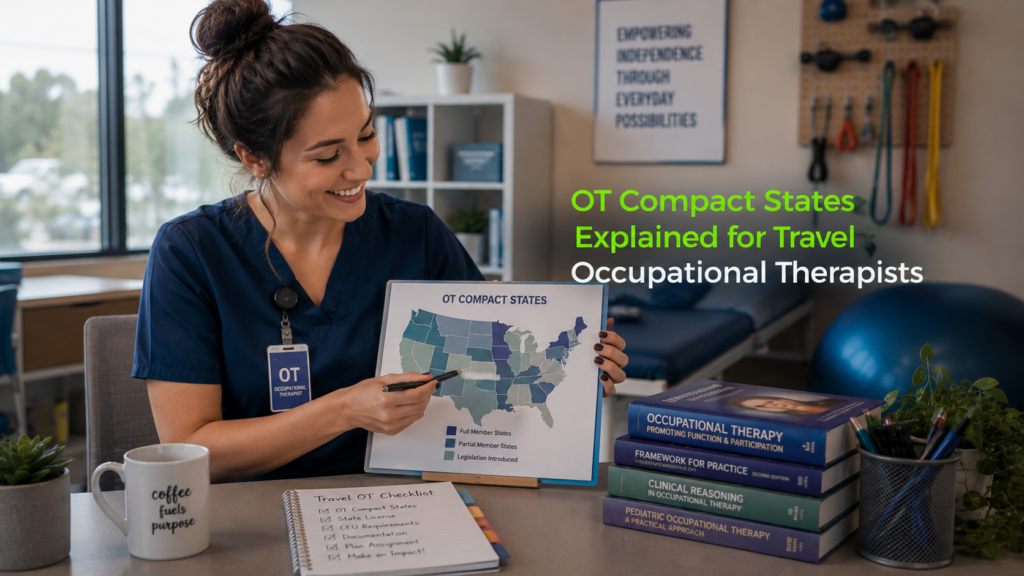 Unlocking Opportunities: The OT Compact for Travel Therapists
Discover the benefits of the Occupational Therapy Licensure Compact for travel OTs, simplifying state licensing and expanding job opportunities across the U.S.
Read article →
 The History of Travel Therapy: How a Flexible Healthcare Career Evolved
Imagine helping patients recover their mobility in Colorado, supporting children with speech development in Texas, or helping older adults regain independence in Florida—all while…
Read article →
 The Ultimate Guide to Travel Healthcare Credentialing: Fast Track Your Career
Streamline your travel healthcare career with essential credentialing tips and personal support from Anders Group for hassle-free assignments.
Read article →